
Stołki (Stools)
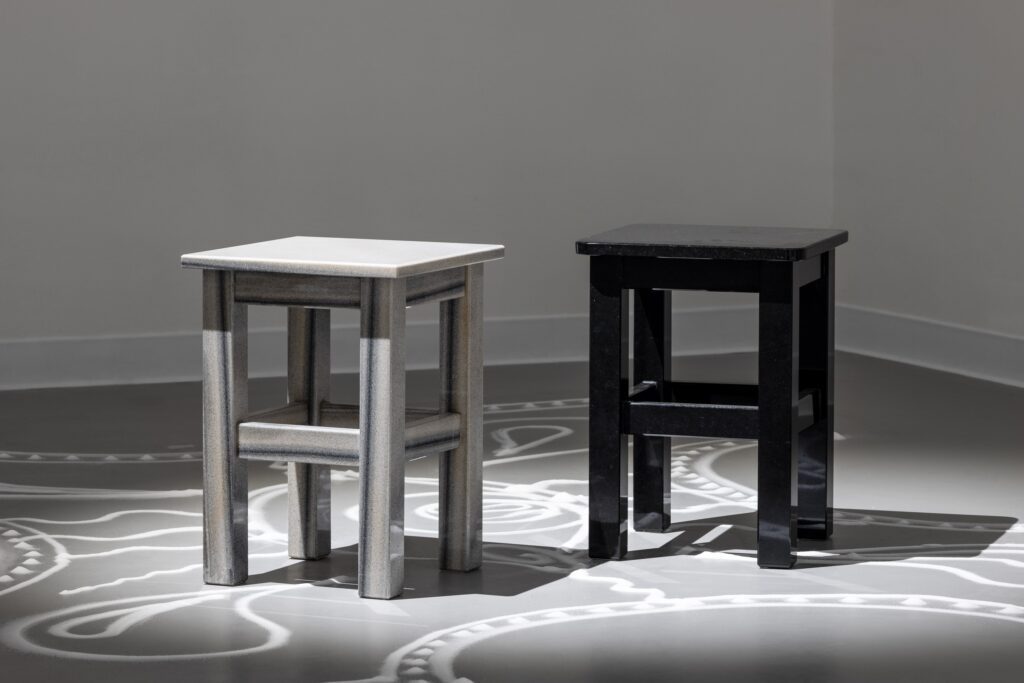
A sculpture depicting two stools, whose heavy, squat form and the material employed — evocative of Polish postmodern gravestones — is set against the modesty and commonplaceness of a functional piece of furniture. The work makes an ironic reference to post-transformation poverty with its yearning for modernity and opulence. The piece of furniture itself also carries a grotesque constellation of associations: […]
Źródło (Source)

A small, two-element sculpture resembling a kind of garden sundial or miniature fountain. Constructed from two intersecting forms: a marble tray and an alabaster, pearl-inlaid “sausage.” An ironic-erotic composition, distinguished by refined humour and a playful game of associations. The pearls become simultaneously a symbol of semen and a physical manifestation of the suffering of the mollusc, which surrounds an irritating grain of […]
Uranos

The sculpture references the story of Aphrodite’s birth as described by Hesiod in the Theogony. The genitals of Uranus, severed by Cronus’s sickle at Gaia’s instigation, fell into the sea, and from the white foam surrounding them the goddess of beauty emerged. Set into a male head carved from white Pińczów limestone is a conch shell that lends the work a phallic character. […]
Nasienie (Seed)

A small work consisting of four marble tiles bearing rye ears and natural pearls. The artist employs minimalist means of expression, building tensions between the geometric form and permanence of marble and the natural beauty of the pearls and ears of grain. The veining of the marble recalls furrows of ploughed earth, yielding harvests of pearls.
Igła (Needle)

An oversized marble needle with a single pearl, suspended in a precarious state of equilibrium between stability and collapse. An object combining both phallic and vaginal elements simultaneously. The needle — a tool associated with women’s work, capable of drawing blood yet unsuited for use as a weapon — is, through enlargement, transformed into a dangerous and potentially lethal object.
Panna młoda (Bride)

Formally, the work is built upon the contrast between a large block of white marble inlaid with natural pearls and the delicate structure of a wedding dress. The sculpture is a kind of totemic fetish, shamelessly protruding from a coquettishly draped garment. The gesture of the artist dressing the sculpture is of particular significance here, as it endows it with […]
Górnik (Miner)

The work brings together multiple artistic traditions: from monumental Socialist Realist sculpture with its homoerotic predilection for powerful figures of labour vanguards, through the Surrealist objects of Władysław Hasior and elements of Kantor’s imaginarium, to the Italian movement of arte povera. The enormous striding figure is constructed from mining tools — pickaxes, ladders, chains — set against granite […]
Wyżymanie (Wringing)

The spindle-shaped, monumental form constructed from characteristic pasiaki — folk textiles sold during the People’s Republic of Poland era through the Central Bureau of Folk and Artistic Industry, “Cepelia” — recalls an enormous dress, majestically spinning in an unsettling, slowed movement. The artist references the Tower of Fire by Bauhaus-affiliated Johannes Itten, who, alongside his studies in colour theory, was […]
Iglica (Spire)

The form of the sculpture — a kind of tripod — may evoke a pyre of wood stacked for lighting a fire. A pyre that offered protection against the cold, but also a place where women accused of witchcraft were put to death. The oversized bones lend the work a monumental character, referencing the figures of mythical giants — whose existence was purportedly evidenced by mammoth […]
Kraków Culture | Mateusz Okoński. Osobliwy
 Polish
  English