


On the darkness-shrouded stage, one can hear the creaking of floorboards beneath footsteps. A sound akin to that produced by old parquet floors in the stifling Kraków apartments of nineteenth-century tenement houses.
Slowly warming spotlights gradually draw forth from shadow a procession of figures.
Bones and jewels.
The viewers’ excitement resembles that which Howard Carter and Lord Carnarvon must have experienced, inflamed by the prospect of plundering the treasures from Tutankhamun’s tomb. In the name of science.
The Earl, however, was not destined to remain long in ecstatic rapture. Shortly thereafter, he died under mysterious circumstances, and the event became perfect fodder for the press writing about ancient curses, corpses, and other extraordinariness.
Uncanny tales, erudite narratives in which truth intertwines with fiction, constitute the fabric of the stories that Okoński constructs in his sculptural installations.
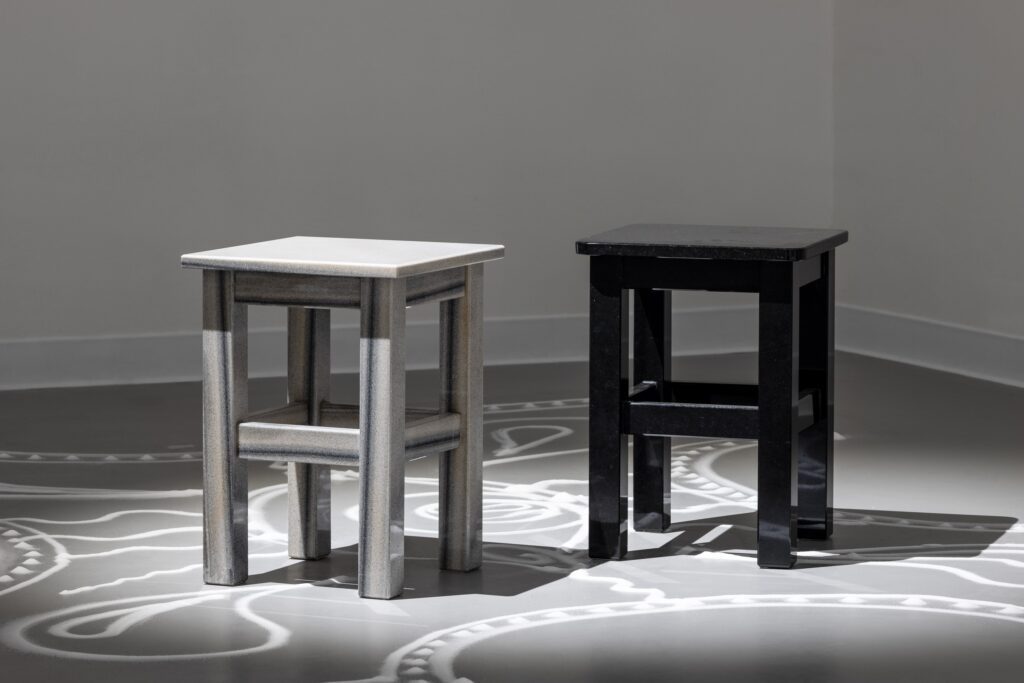
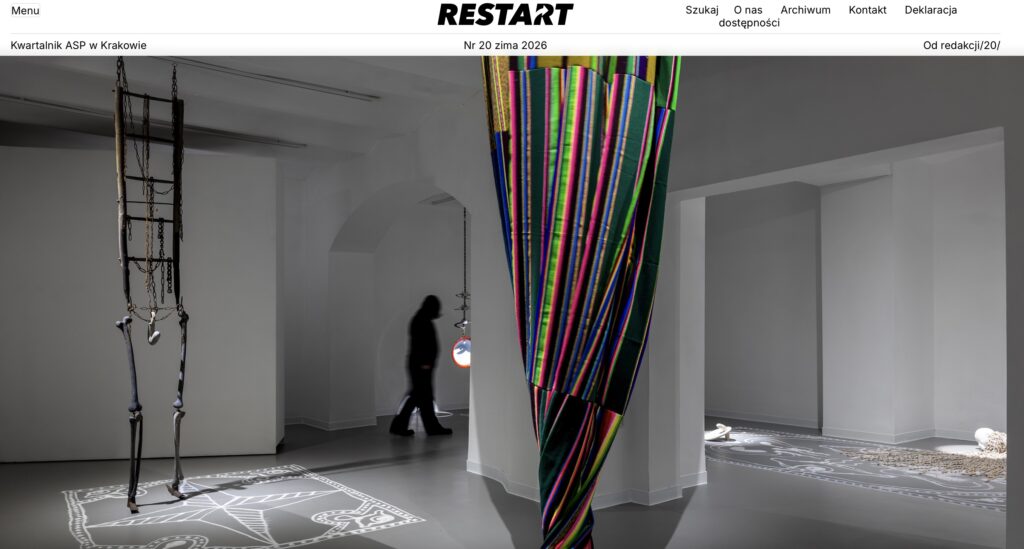
Objects—islands amidst meandering lines of salt drawings. Inhabited by beautiful youths. Or what remains of them.
Secret rituals, myths and symbols, Eros and Thanatos.
Skeletons in the closet.

Mateusz Okoński
Sculptor, collector, curator, director, performer, exhibition designer, jewelry creator, cultural animator, activist, storyteller, connoisseur, personality, eccentric, phenomenon. It is extraordinarily difficult to confine Okoński’s figure within simple frameworks, and his remarkable creative journey constitutes an intriguing narrative deeply immersed in his fascination with art history and culture.
Born in Kraków in 1985, he completed his studies at the Faculty of Sculpture at the Jan Matejko Academy of Fine Arts. Kraków, with its powdered façade of urban intelligentsia rituals, noble lineages and ecclesiastical hierarchies, along with its underground fabric of damp cellars housing once smoke-filled taverns, artists’ studios and gay clubs, constitutes one of the foundations of the artist’s sensibility.
Okoński’s apartment is a cabinet of curiosities. Not in the figurative sense. Upon the bewildered guest at the artist’s receptions gaze figures from hanging tapestries and antique portraits framed in heavy gilt frames. From every corner of the space emerge curiosities: taxidermied crocodile bodies, skulls, ritual sculptures, exquisite ornaments and intricate votive offerings. The impressive collection is not static; it undergoes constant transformations that make the structure curated by Mateusz Okoński resemble more a metamorphosing organism pulsating with vital energy than the cold space of museum architecture.

“That Swine, Okoński!” Thus titled his text on the sculptural installation “Purification” Wojciech Szymański, critic and independent curator, co-author of the curatorial concept for the Polish Pavilion at the 59th Venice Art Biennale. The placement of a marble pig on a concrete pedestal protruding above the Vistula’s surface, resting on a pyre and referencing the ritual of burnt offering, constituted one of the most important Kraków artistic events of 2010. Noble material, a theme drawn from mystical ritualism, and a refined play with corporeality would become significant motifs in the artist’s later work.
In subsequent years, Okoński creates numerous sculptures, objects and installations, focusing both on themes drawn from his collector’s pursuits and on threads related to identity, corporeality and ritualism. Together with Jakub Skoczek and Jakub Woynarowski, he establishes the artistic group “Quadratum Nigrum,” which explores the connections between modernism, mysticism and the rituals of secret societies.
An important aspect of the artist’s work also comprises his experimental performances, inspired by the aesthetics of the Bauhaus Triadic Ballet and the pre-war Cricot Artists’ Theatre. The geometric aesthetic of modernism would constitute the construction of the artist’s refined, minimalist solo exhibition “Thoth” at Galeria Aristoi in 2016.

An important work by Mateusz Okoński is the monumental sculptural installation “Pasiak” presented at the exhibition “50 Years After 50 Years of the Bauhaus” at Kunstverein Stuttgart. In it, the artist collides Johannes Itten’s Bauhaus-related “Tower of Fire” concept with the folk aesthetic of “Pasiaks” produced by the Central Office of Folk and Artistic Industry, constructing a multi-layered narrative accentuating themes of colonialism and systems of oppression.
In subsequent realizations, the artist focuses on the subtle tensions of forms derived from male corporeality, juxtaposed with attributes of power, violence and labor, creating compositions that reveal the physical dimension of working with sculptural matter.
Okoński, beyond his own creative practice, has also co-created and organized numerous cultural initiatives including: the “Culture Tank” project of the Lesser Poland Institute of Culture, focused on showcasing the most interesting artists of the younger generation, the “Hejnał Expedition Art Festival” in Minsk and the Ecuadorian Jungle, the “Microart 1:10” project, the “Salt” project addressing the disappearing urban craft traditions in the context of gentrification processes, efforts to save Kraków’s modernist heritage, and many others. He is also the author of exhibition designs for several dozen shows in prestigious centers in Poland and abroad.
Kuba Skoczek






 Polish
  English