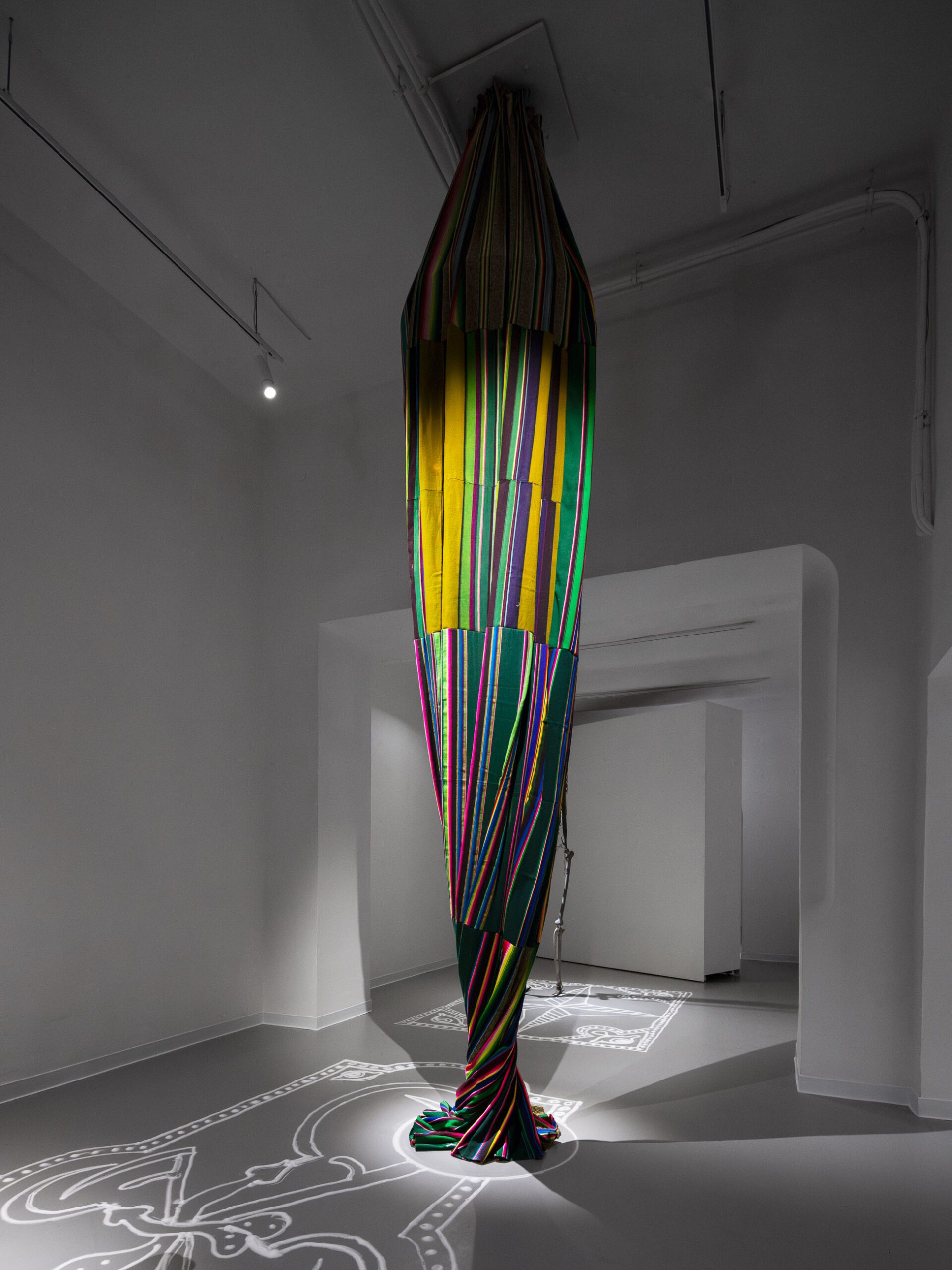
The spindle-shaped, monumental form constructed from characteristic pasiaki — folk textiles sold during the People’s Republic of Poland era through the Central Bureau of Folk and Artistic Industry, “Cepelia” — recalls an enormous dress, majestically spinning in an unsettling, slowed movement. The artist references the Tower of Fire by Bauhaus-affiliated Johannes Itten, who, alongside his studies in colour theory, was also engaged with esoteric philosophy derived from Mazdaist concepts. The form of the pasiaki evokes strong associations with the folk art of the indigenous peoples of the Americas. In this context, the sculptural installation may be read as a totem uniting elements of Slavic tradition with the ancient cultures of the American continent. An important point of reference here are the words attributed to Frederick the Great, who contemptuously referred to the inhabitants of Poland as the “Iroquois of Europe,” pointing to their supposed savagery and primitiveness as obstacles to the process of modernisation. The striped patterns also evoke associations with prison garb as attire that dehumanises the figure of the captive. The exploration of these tensions — and in particular the juxtaposition of themes of wildness and vulgarity against the modernist concept of geometric order — forms the axis of much of Okoński’s creative practice.



 English
  Polish